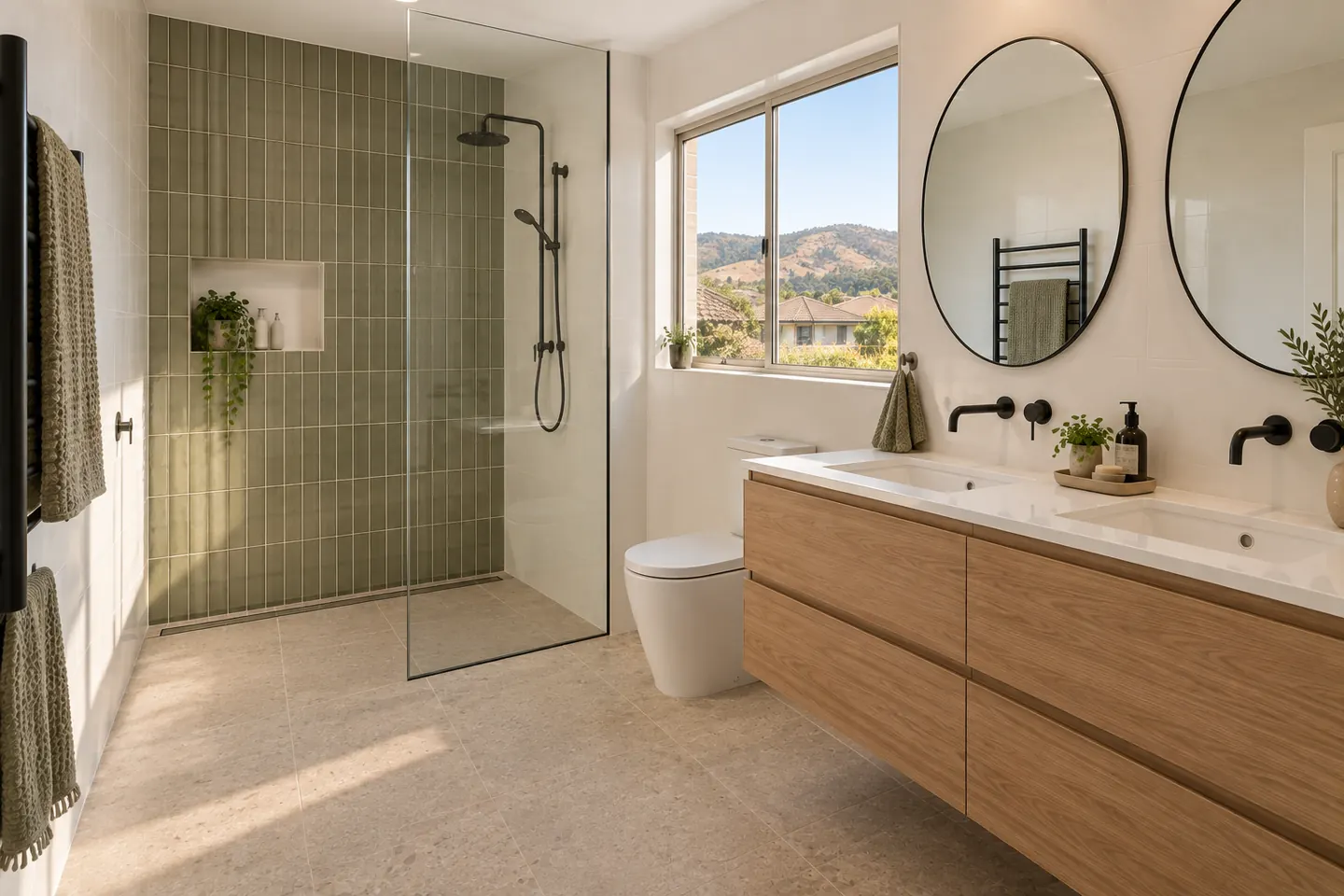
Two different jobs
Renovating an existing ensuite is common in homes from the 1990s onward, particularly in estates like Glen Alpine and Mount Annan. The room is sound but tired: a cramped corner shower, a single basin, not enough storage, no real ventilation.
Adding a second bathroom is common in older homes in Campbelltown, Leumeah, Ingleburn, Ambarvale and Minto, many of which were built with one bathroom and a separate toilet for a three- or four-bedroom house.
Both come down to the same thing: helping a household that has outgrown its bathrooms.
Renovating an existing ensuite
The typical ensuite in a 1990s or 2000s Macarthur home measures somewhere around 2 by 2.5 metres. The usual upgrades:
- Corner shower becomes a walk-in with a fixed glass panel, generally on the existing waste
- Single vanity becomes a wider unit with drawers, sometimes with two basins if the wall allows
- A shaving cabinet is recessed into the stud wall for extra storage
- The tile line goes to the ceiling, removing the painted strip that peels in a steamy room
- An exhaust fan is ducted outside, often for the first time
Because these homes are mostly post-1990, asbestos is less likely, though a later check is still sensible if the house has an older section or has been extended.
Adding a second bathroom
Step one: find the space
Common candidates in Campbelltown-area homes:
- The walk-in robe off the main bedroom
- Part of an oversized main bedroom, with the robe relocated
- An enclosed back verandah or sunroom
- The separate toilet plus part of the hallway, turned into a small bathroom while a new powder room goes elsewhere
- Part of a large laundry, turned into a powder room or shower room
Step two: check the drainage
A new toilet and shower need a sewer connection at the correct grade. We find where the existing sewer line runs and plan the shortest practical route.
On a timber floor with a crawl space, pipes run under the house. This is relatively simple.
On a concrete slab, a trench is cut through the slab to lay the new pipes, then re-poured. It is noisy, dusty and adds cost, but it is routine.
Step three: check the hot water
Many homes from the 1970s and 1980s still run a hot water system sized for a single bathroom. Two showers back to back can exhaust it. Options include a larger storage tank, a continuous-flow gas unit where gas is connected, or a heat pump. We raise it at the measure rather than after the first cold shower.
Step four: ventilation and light
An internal ensuite with no window needs an exhaust fan ducted to outside. In a converted robe, a skylight or solar tube can bring daylight in where the roof allows.
Step five: approvals
Internal work that does not touch the structure is often exempt development. Removing or altering a load-bearing wall, adding a new window, or work on a heritage-listed property can change that. Most of the area is under Campbelltown City Council; Mount Annan and Gregory Hills fall under Camden Council. We tell you what is likely, and a certifier or council confirms it.
Powder rooms
Where a full ensuite will not fit, a powder room — toilet and basin only — still takes enormous pressure off the main bathroom at peak times. Under the stairs in a two-storey home, in part of the laundry or at the end of a hallway can all work. As a 2026 guide, a new powder room typically costs $12,000 to $20,000 including new plumbing; renovating an existing one, $9,000 to $14,000.
Living through it
Adding a bathroom is less disruptive than renovating the only one, because the existing bathroom keeps working. The noisy stages are cutting the slab and demolition. The rest is a steady sequence of trades.
What it costs
| Project | 2026 guide |
|---|---|
| Existing ensuite refit | $15,000 – $26,000 |
| New ensuite from a robe or bedroom | $28,000 – $50,000 |
| New powder room | $12,000 – $20,000 |
| Existing powder room refresh | $9,000 – $14,000 |
The price page explains what moves these numbers.
The builder
Renovation work is carried out in partnership with Coastal Renovation Group, a licensed NSW builder. Licence and insurance details are provided on request.
Call 02 4601 3691 or tell us about the space.
Questions people ask before they commit
Can a walk-in robe become an ensuite?
Often, if it is at least about 1.8 by 1.8 metres and there is a practical route for the waste pipes to reach the sewer. On a timber floor that route is usually straightforward; on a concrete slab it means cutting a trench, which adds cost but is still very common.
What does adding a second bathroom cost?
As a 2026 guide, converting existing space into a new ensuite typically costs $28,000 to $50,000. The range depends mainly on how far the drainage has to run, whether the slab needs cutting, and whether the hot water system needs upgrading.
Do we need council approval to add an ensuite?
Internal alterations that do not change the structure are often exempt development, but changes to load-bearing walls, new windows and some other work can need a complying development certificate or a development application. Campbelltown City Council or Camden Council, or a certifier, can confirm for your property.
Will our hot water system cope with another bathroom?
Sometimes not. A small electric storage tank sized for one bathroom can run out when two showers run back to back. We check the system's capacity and discuss options such as a larger tank, a continuous-flow gas unit or a heat pump.
What does renovating an existing ensuite cost?
As a 2026 guide, refitting an existing ensuite in the same footprint typically costs $15,000 to $26,000. Replacing a corner shower with a larger walk-in shower and adding storage are the most common changes.