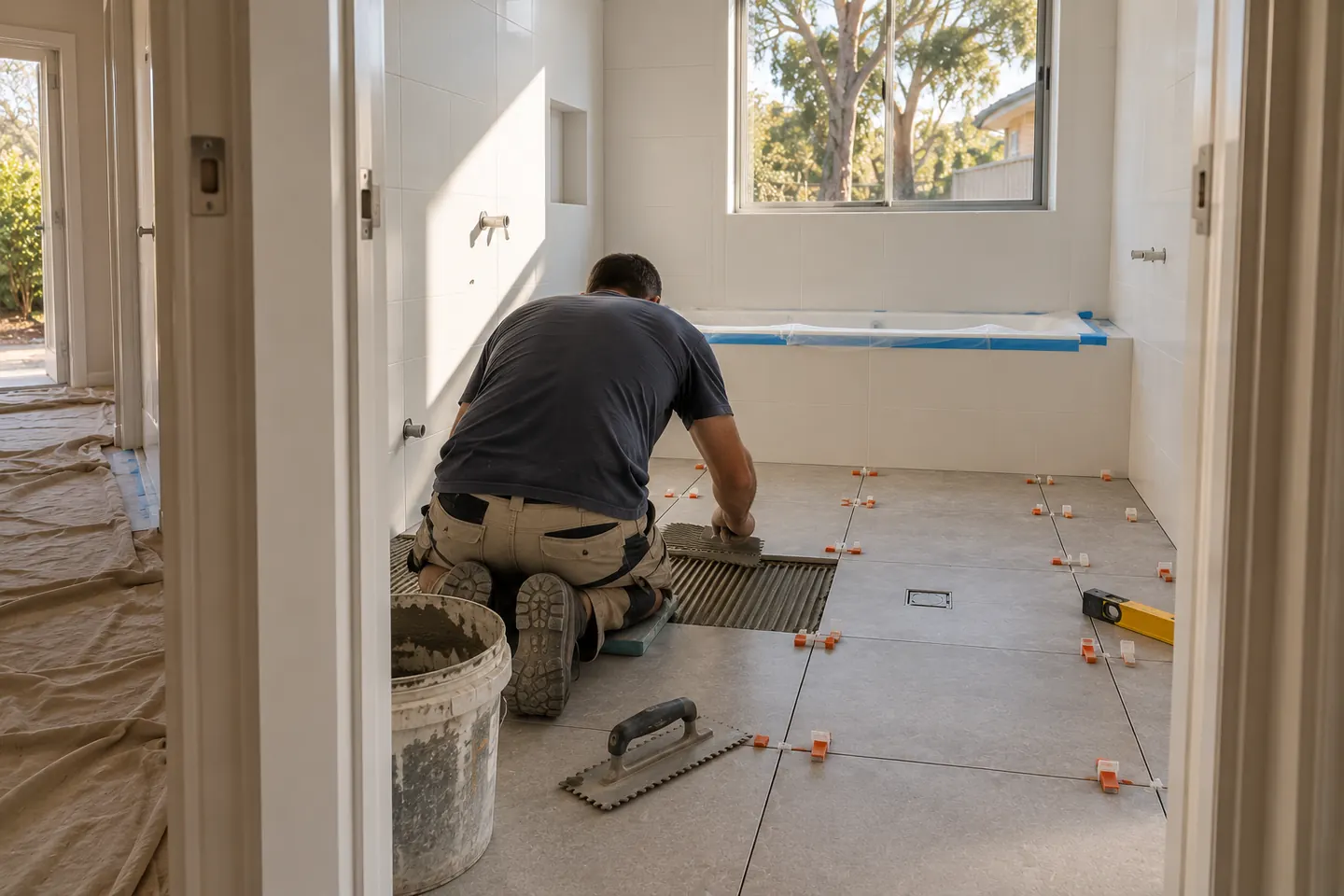
Tiling for how the room is used
Most bathroom tile advice is about colour. In a family home, the more useful questions are:
- Is it safe when wet?
- Will the grout stay clean?
- Will it chip if something heavy gets dropped?
- Can it be scrubbed without losing its finish?
- Will it still look fine in ten years?
Get those right and there is still plenty of room for style.
Choosing floor tiles
Porcelain over ceramic for floors. Porcelain is harder and denser, so it resists chipping and absorbs very little water.
Matt or textured finish. A slip-resistance classification suitable for wet barefoot areas is the priority in the shower and in front of the bath. Many families use the same tile across the whole floor for continuity, so choose for the wettest area.
Mid-tones and patterns hide more. A pure white or very dark floor shows every hair and footprint. A warm grey, stone-look or terrazzo-look porcelain is more forgiving.
Size. Larger tiles mean fewer grout lines to clean. On a shower floor, a smaller tile makes it easier to form falls to the drain; a linear drain allows a larger tile to be used throughout.
Choosing wall tiles
Full height in the shower and ideally on every wall. Less painted plasterboard means fewer places for mould and peeling.
Gloss or satin finishes wipe clean easily on walls.
A feature, if you want one, in a niche, behind the vanity or on the shower wall. Keep it to one surface so the room stays calm.
Grout
Epoxy grout on shower floors and walls — it resists stains, soap scum and mould. It costs more and needs an experienced tiler.
Colour-matched or mid-tone grout hides everyday dirt better than bright white.
Flexible sealant in every internal corner and where tiles meet the bath, vanity and floor. On the reactive clay soils common around Campbelltown, houses move slightly, and rigid grout in a corner will crack.
Preparation matters more than the tile
The best tile in the world cracks if the preparation is wrong. Before tiling:
- The floor is flat and set to fall toward the waste
- The membrane has fully cured
- Wall sheets are fixed correctly and level
- Movement joints are planned for larger floors and where the slab has a joint
During tiling, adhesive coverage under each tile is checked, particularly with large-format tiles.
Set-out
A good tiler plans where the cuts will fall before laying the first tile. Cuts are placed in corners and behind the door rather than at the most visible edge. Grout lines are aligned with the niche, shower glass and vanity top. The drain sits neatly on the tile grid.
Tiles and the Macarthur climate
Hot summers and cold winters mean tiled floors can feel cold underfoot in July. Options include:
- Underfloor heating — an electric mat under the tiles, on its own circuit
- A heated towel rail to warm the room
- A bath mat, the low-tech solution
In summer, a tiled bathroom stays cool, which is welcome on a 40-degree day.
Budget and tile allowance
Your quote should state a tile allowance per square metre. Porcelain tiles from mainstream ranges keep costs sensible. Labour increases with small mosaics, herringbone, very large-format tiles and mitred corners.
As a guide, choose the format and finish first, then the colour within your allowance.
Regrouting and repairs
If your tiles are sound but the grout is stained, cracked or mouldy, regrouting and resealing can refresh a bathroom for a fraction of a renovation. If tiles are drummy or water is getting behind them, that points to a membrane problem — see waterproofing.
The builder
Renovation work is carried out in partnership with Coastal Renovation Group, a licensed NSW builder. Licence and insurance details are provided on request.
See main bathroom renovations or the price bands. Call 02 4601 3691 or send photos.
Questions people ask before they commit
What tiles are best for a family bathroom?
Porcelain is the practical choice — dense, hard-wearing and low in water absorption. On the floor, choose a tile with a slip-resistance classification suitable for wet barefoot use. On walls, glazed ceramic or porcelain both work well.
What slip rating do we need?
Slip resistance is classified under AS 4586. For shower floors and wet barefoot areas, a P3 classification or better is the common recommendation. Highly polished floor tiles are not a good idea in a bathroom used by children.
What grout is easiest to keep clean?
Epoxy grout resists staining and mould far better than standard cement grout and suits shower floors. A mid-tone grout colour hides everyday marks better than bright white.
Should we tile to the ceiling?
In a family bathroom, yes, at least in the shower. It removes painted plasterboard that gets splashed and steamy, and makes the whole room easier to wipe down.
Why do some tiled floors crack?
Common causes are house movement on reactive clay, tiles laid without enough adhesive coverage, and missing movement joints. Correct substrate preparation, full adhesive coverage and flexible sealant at junctions reduce the risk.