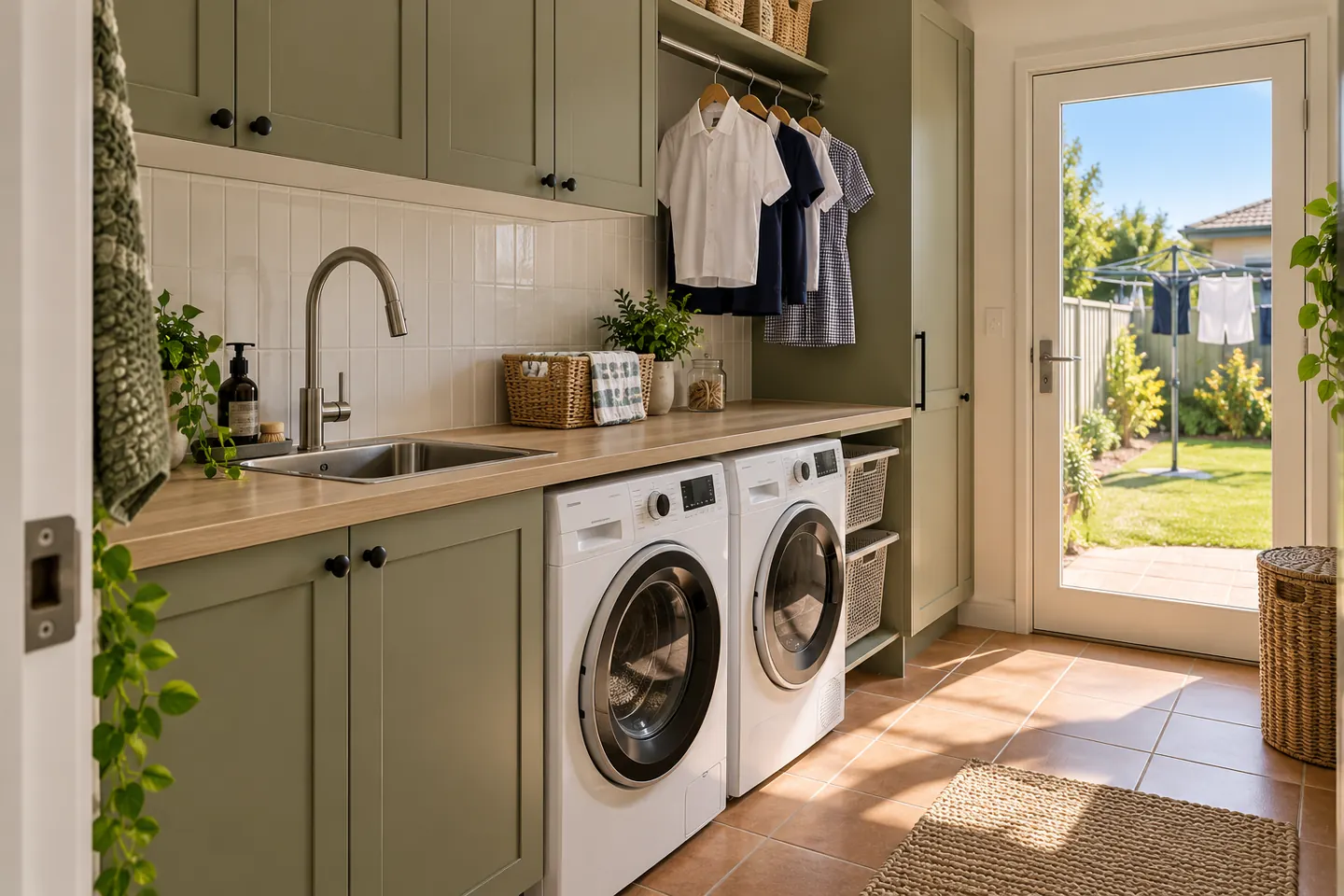
The laundry most homes started with
In a typical 1970s or 1980s Campbelltown-area home, the laundry is a small room off the kitchen or the back door with:
- A single stainless or concrete tub on a metal stand
- A space for the washing machine, maybe a shelf above it
- No benchtop for folding
- No storage beyond whatever has been added since
- A back door to the clothesline
- Fibre cement lining in some homes, which needs an asbestos test before removal
Newer estate homes do better, but even those laundries tend to be narrow galley rooms with limited bench space.
What a family laundry needs
Bench space. Somewhere to fold. A benchtop over a front-loading washer and dryer side by side is the most efficient arrangement.
Storage for everything that is not clothes. The mop, the bucket, the vacuum, the ironing board, cleaning products out of reach of children, spare toilet paper and pantry overflow.
Hanging space. A rail or retractable line for drip-dry items and school uniforms.
A proper tub. Big enough to soak muddy sports gear, with a tall mixer and a pull-out spray.
A sorting system. Pull-out baskets under the bench for lights, darks and sports clothes.
Layouts that work
Front-loaders under a bench. Washer and dryer side by side, benchtop over, tub at one end, overhead cupboards above.
Stacked machines. Where the room is narrow, the washer and dryer stacked in a tall cupboard free the rest of the wall for a tub and bench.
Laundry and mudroom. In homes where the laundry is the back entry, adding a bench seat, hooks and shoe storage turns it into a drop zone for school bags and sports gear.
Drying in a Macarthur climate
Summers in the area are hot and dry enough for outdoor drying most days. Winters are colder than the coast, with frosty mornings, and washing dries slowly.
- A heat pump dryer costs more to buy but uses far less electricity than a vented dryer, and does not pump hot, damp air into the room
- An exhaust fan ducted outside clears moisture from indoor drying
- A ceiling-mounted airer uses space that is otherwise wasted
Moving the laundry
Some families want the laundry closer to the bedrooms, or want to convert the old laundry into a powder room and move the laundry into a garage or hall cupboard. This involves new plumbing and drainage. On a slab, it may mean cutting a trench. It is worth considering alongside a bathroom project, when the plumber is already on site.
Waterproofing and floors
The laundry floor is waterproofed along with the wall junctions and the area around the tub. A floor waste is strongly recommended in case a hose bursts. Tiles should be slip-resistant, and grout should be a stain-resistant type.
Finishes that stand up to family life
- Moisture-resistant carcasses with sealed edges
- Laminate or compact laminate doors and benchtops
- Soft-close hinges and drawers rated for heavy use
- Child-safe latches on the cabinet holding chemicals
- A tall mixer with a pull-out spray at the tub
Cost
As a 2026 guide: a laundry renovation in the same position, $9,000 to $18,000; with extensive cabinetry or relocation, $18,000 to $28,000. Asbestos removal, if needed, is priced separately after testing. The price page has more detail.
The builder
Renovation work is carried out in partnership with Coastal Renovation Group, a licensed NSW builder. Licence and insurance details are provided on request.
Call 02 4601 3691 or send the laundry details.
Questions people ask before they commit
What does a laundry renovation cost in Campbelltown?
As a 2026 guide, a straightforward laundry renovation in the same position typically costs $9,000 to $18,000. Adding a lot of cabinetry, moving plumbing or removing asbestos sheeting pushes it toward $20,000 or beyond.
Is it cheaper to renovate the laundry with the bathroom?
Usually, yes. The plumber, electrician, waterproofer and tiler are already coming, and the skip is already on site. Doing both together costs less than two separate jobs.
Does a laundry need waterproofing?
Yes. A laundry is a wet area under the building standards, so the floor and wall junctions are waterproofed and the area around the tub protected. It matters in a busy family laundry where the machine floods occasionally.
Can we dry clothes inside without mould?
It helps to have a heat pump or condenser dryer, a ducted exhaust fan, and some hanging space near the exhaust. In Macarthur winters, when outdoor drying is slow, good ventilation makes a real difference.
What benchtop is best in a laundry?
Compact laminate and standard laminate are hard-wearing and affordable; porcelain and stainless steel also work. Engineered stone is no longer an option — it has been banned in Australia since 1 July 2024.